
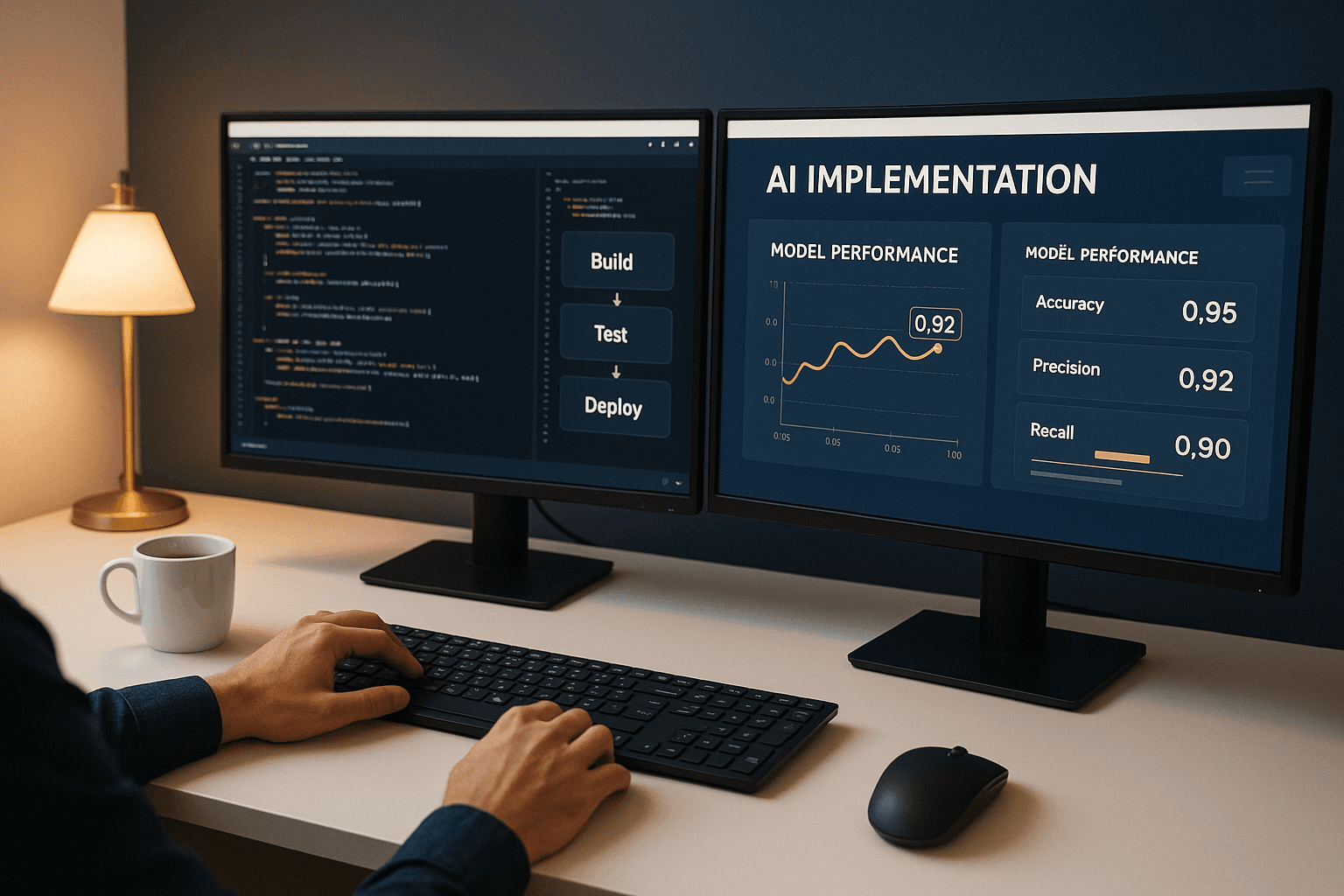
AI Agent Evaluation: How to Test, Measure, and Trust Your AI Workforce
Deploying AI agents is one thing. Knowing whether they're actually working is another. A practical framework for evaluating AI agent performance in business — from accuracy metrics to trust calibration.
AI Agent Evaluation: How to Test, Measure, and Trust Your AI Workforce
You've deployed an AI agent. It's processing customer emails, or drafting reports, or managing your calendar. It seems to be working. But how do you actually know?
This is the uncomfortable gap in most AI deployments in 2026. Companies invest significant time and money building agent workflows, then evaluate them with vibes. "It seems pretty good." "The team likes it." "I haven't seen any major errors lately."
That's not evaluation. That's hope.
If you're trusting AI agents with real business operations, you need a proper evaluation framework — one that tells you what's working, what's failing, and where the risks are hiding. Here's how to build one.
Why Agent Evaluation Is Different
Evaluating a traditional software system is straightforward. Did the function return the expected output? Does the API respond within 200ms? Is the database consistent?
AI agents break this model in several ways:
Non-determinism. The same input can produce different outputs. An agent asked to summarise a meeting might emphasise different points each time. This doesn't mean it's wrong — but it means "expected output" testing is insufficient.
Cascading decisions. Agents make chains of decisions. An email triage agent decides the category, then the priority, then the routing, then the response. An error in step one cascades through every subsequent step.
Context sensitivity. Agent quality depends on context — the time of day, previous interactions, the specific data available. An agent that performs brilliantly on your test data might struggle with real-world edge cases.
Subjective quality. Was that email response "good"? It depends on tone, accuracy, completeness, and the recipient's expectations. There's no single correct answer.
The Evaluation Framework
Level 1: Task Completion Rate
The most basic metric: does the agent complete its assigned tasks?
What to measure:
- Percentage of tasks completed without human intervention
- Percentage of tasks completed correctly (verified by human review)
- Percentage of tasks that required human correction
- Percentage of tasks that failed or were abandoned
How to measure: Implement logging on every agent action. Tag each task with an outcome: completed, completed_with_correction, escalated, failed. Review a random sample weekly.
Benchmarks: A well-configured agent should achieve 85%+ completion without intervention for routine tasks. Below 70% indicates a fundamental problem.
Level 2: Accuracy and Quality Scoring
Task completion doesn't tell you about quality. An agent might complete every email response but write them poorly.
What to measure:
- Factual accuracy: Are the agent's claims and references correct?
- Completeness: Did the agent address all aspects of the task?
- Tone and style: Is the output appropriate for the context?
- Relevance: Did the agent include unnecessary information or miss key points?
How to measure: Create a rubric specific to each agent's domain. Score a sample of outputs weekly on a 1-5 scale across each dimension. Track trends over time.
Example rubric for an email drafting agent:
| Dimension | 5 (Excellent) | 3 (Acceptable) | 1 (Poor) |
|---|---|---|---|
| Accuracy | All facts correct, proper references | Minor inaccuracies, non-critical | Factual errors that could embarrass |
| Completeness | Addresses all points, includes context | Covers main points, misses secondary | Misses key points or requirements |
| Tone | Matches company voice perfectly | Generally appropriate, minor issues | Wrong tone for recipient/situation |
| Efficiency | Concise, no wasted words | Some verbosity but acceptable | Rambling or too terse |
Level 3: Error Analysis
Not all errors are equal. Understanding what your agent gets wrong is more valuable than knowing its overall error rate.
Categorise errors by type:
- Hallucination: Agent invents facts, quotes, or references
- Omission: Agent misses information it should have included
- Misinterpretation: Agent misunderstands the task or context
- Format error: Correct content, wrong structure or presentation
- Boundary violation: Agent acts outside its authorised scope
- Tone mismatch: Right content, wrong delivery
Categorise errors by severity:
- Critical: Could cause financial loss, legal issues, or reputational damage
- Significant: Requires human correction before use
- Minor: Suboptimal but acceptable without correction
- Cosmetic: Formatting or style issues with no functional impact
Track error patterns over time. If hallucination rates increase, your knowledge base may be outdated. If omission errors spike, the agent might be hitting context window limits. Error patterns are diagnostic tools.
Level 4: Latency and Efficiency
An agent that takes 10 minutes to draft an email saves no time if a human could do it in 5.
What to measure:
- Time to completion: How long does the agent take per task?
- Cost per task: API calls, compute, and infrastructure costs
- Human time saved: Net time reduction compared to fully manual process
- Throughput: Tasks processed per hour/day
The ROI equation: (Human time per task × Task volume) − (Agent cost per task × Task volume + Human review time). If this number isn't positive, the agent isn't earning its keep.
Level 5: Trust Calibration
The most nuanced and arguably most important level: how well does the agent know what it doesn't know?
What to measure:
- Appropriate escalation rate: Does the agent escalate when it should? (Not too much, not too little)
- Confidence calibration: When the agent expresses confidence, is it right? When it expresses uncertainty, was the task genuinely ambiguous?
- Boundary respect: Does the agent stay within its defined scope?
- Graceful failure: When the agent can't complete a task, does it fail informatively?
The gold standard: An agent that says "I'm not confident about this — here's my best attempt, but please review carefully" is more trustworthy than one that confidently presents wrong answers. Trust calibration is about matching stated confidence to actual reliability.
Building Your Evaluation Pipeline
Step 1: Instrument Everything
Before you can evaluate, you need data. Ensure every agent interaction is logged:
- Input received (task description, context, data)
- Decisions made (each step in the agent's reasoning)
- Output produced (final result)
- Human feedback (corrections, approvals, rejections)
- Time and cost metrics
Storage: A simple database table works. You don't need a specialised ML ops platform for this.
Step 2: Establish Baselines
Before optimising, establish where you are:
- Run your agent on 50-100 representative tasks
- Have a human expert evaluate each output using your rubric
- Calculate baseline metrics across all levels
- Document the baseline — this is your comparison point
Step 3: Implement Continuous Sampling
You can't review every agent output. Instead:
- Random sampling: Review 5-10% of all outputs weekly
- Edge case flagging: Automatically flag outputs where the agent expressed low confidence or took unusual actions
- User feedback collection: Make it easy for people who receive agent outputs to report issues
- Adversarial testing: Periodically send the agent deliberately tricky inputs to probe its boundaries
Step 4: Weekly Review Cadence
Set a 30-minute weekly review:
- Review sampled outputs against rubric (15 min)
- Analyse error patterns and trends (10 min)
- Identify improvement actions — prompt adjustments, knowledge base updates, scope changes (5 min)
Step 5: Monthly Performance Report
Compile monthly metrics into a one-page report:
- Task completion rate (trend)
- Average quality score (trend)
- Error rate by category (trend)
- Cost per task and total ROI
- Notable incidents or improvements
- Actions for next month
Common Evaluation Mistakes
Mistake 1: Testing Only Happy Paths
Your agent works perfectly on the 80% of tasks that are straightforward. But the 20% of edge cases — unusual requests, ambiguous instructions, conflicting information — is where real damage happens.
Fix: Deliberately include edge cases in your evaluation. What happens when the agent receives contradictory instructions? Incomplete data? A request outside its scope?
Mistake 2: Ignoring Drift
AI agent performance degrades over time as the world changes and the agent's training data becomes stale. Customer questions evolve. Business processes update. New products launch.
Fix: Track performance metrics over time, not just current snapshots. A 2% monthly decline in accuracy compounds to a 22% decline over a year.
Mistake 3: Over-Relying on Automated Metrics
Automated metrics (completion rate, response time) are necessary but insufficient. They miss quality nuances that only human review can catch.
Fix: Always include human evaluation as part of your framework. Automated metrics tell you what; human review tells you why.
Mistake 4: No Feedback Loop
Evaluating without acting on the results is just bureaucracy.
Fix: Every evaluation cycle should produce at least one concrete improvement action — a prompt refinement, a knowledge base update, a scope adjustment, or a process change.
Scaling Evaluation: When You Have Multiple Agents
As your AI workforce grows from one agent to five or ten, evaluation complexity increases. Some principles for scaling:
Shared rubrics where possible. Tone, accuracy, and completeness standards should be consistent across agents.
Agent-specific metrics where needed. A sales agent might be evaluated on lead conversion contribution. A support agent on resolution rate. A research agent on source quality.
Cross-agent interaction testing. If agents pass work between each other (agent A triages, agent B responds), test the handoff quality, not just individual performance.
Centralised dashboards. One place to see the health of your entire agent workforce. Red/amber/green status per agent, trending metrics, and recent incidents.
The Trust Spectrum
Not every agent task requires the same level of evaluation rigour:
| Risk Level | Example Tasks | Evaluation Approach |
|---|---|---|
| Low | Internal summaries, data formatting, research compilation | Automated metrics + monthly spot checks |
| Medium | Customer email drafts, report generation, scheduling | Weekly sampling + human rubric scoring |
| High | Financial analysis, compliance documents, client-facing communications | Every output reviewed before delivery |
| Critical | Legal documents, medical information, safety-critical decisions | Human-in-the-loop required, agent assists only |
Match your evaluation investment to the risk. Don't spend the same effort reviewing internal meeting summaries as you do reviewing client proposals.
The Bottom Line
AI agents are powerful, but power without accountability is a liability. Every agent in your organisation should have:
- Defined success metrics — what does "good" look like?
- Regular evaluation — how do you know it's meeting the bar?
- Error analysis — what goes wrong, and how do you fix it?
- Trust calibration — can you rely on it, and for what?
- Improvement feedback loops — how does it get better over time?
The businesses that treat AI agents as team members — with performance reviews, quality standards, and professional development — will outperform those that deploy and forget.
Your AI workforce deserves the same management rigour as your human workforce. Probably more, because it won't tell you when it's struggling.
Need help building an evaluation framework for your AI agents? Contact us for a hands-on workshop tailored to your specific deployment.