
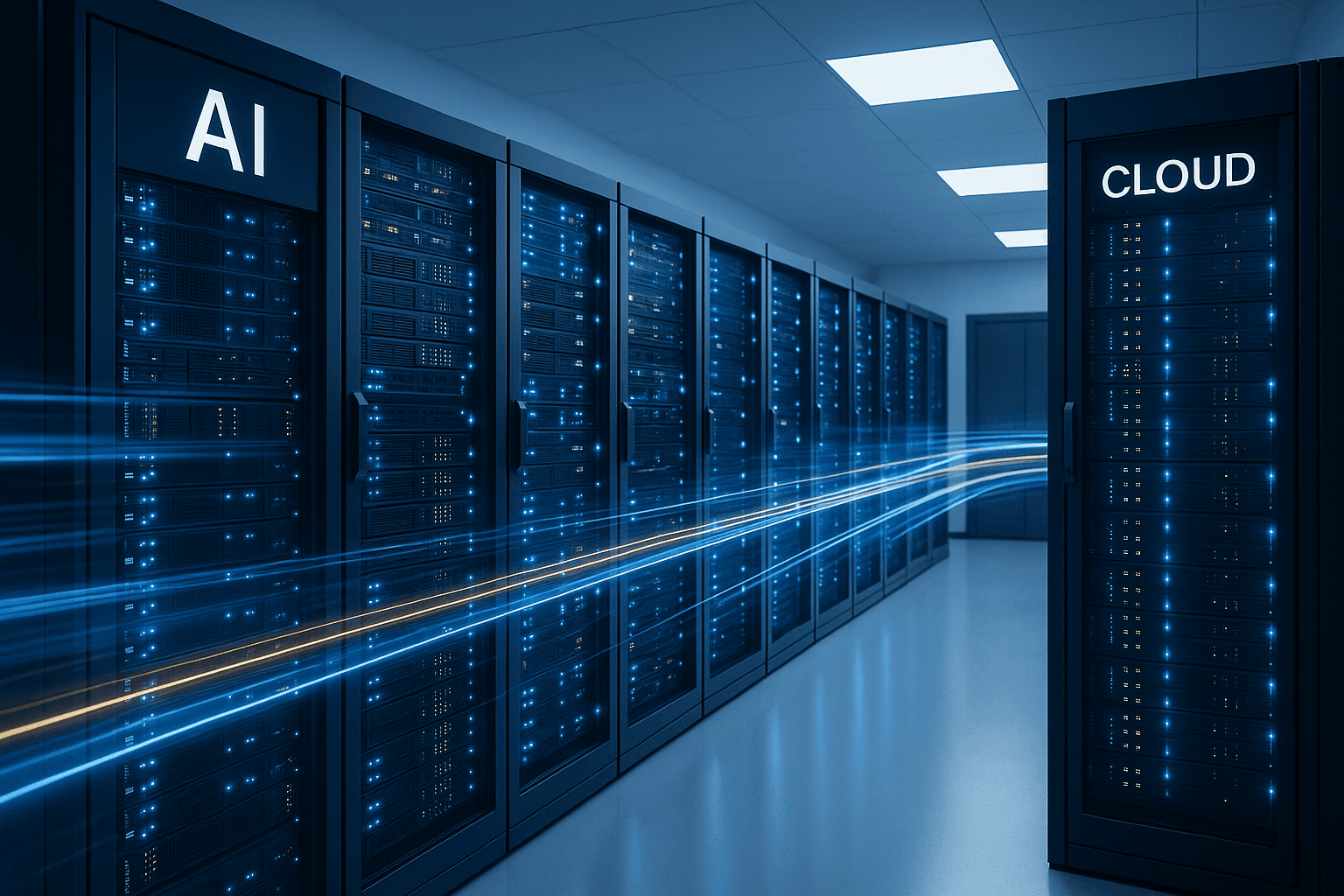
AI for Data Centre & Infrastructure Management: Intelligent Capacity Planning, Cooling, and Operations
How AI is transforming data centre operations — from predictive cooling and capacity planning to automated incident response. A practical guide for UK businesses running on-premise or hybrid infrastructure.
AI for Data Centre & Infrastructure Management: Intelligent Capacity Planning, Cooling, and Operations
Data centres consume roughly 4% of UK electricity. By 2028, that could double — driven almost entirely by AI workloads. The irony isn't lost on the industry: the infrastructure powering AI is itself in desperate need of AI to operate efficiently.
Whether you're running a handful of server racks, managing a colocation environment, or overseeing hybrid cloud infrastructure, AI is changing how infrastructure gets planned, operated, and optimised.
Why Data Centre Operations Need AI Now
Traditional data centre management relies on static thresholds, manual capacity planning, and reactive incident response. That worked when workloads were predictable. They're not anymore.
The challenges:
- Cooling accounts for 30-40% of total energy costs — and most facilities overcool by 15-20%
- Capacity planning is guesswork — teams either over-provision (wasting money) or under-provision (creating bottlenecks)
- Incident detection is too slow — by the time monitoring alerts fire, users are already affected
- AI workloads are spiky — GPU inference and training loads don't follow traditional patterns
- Energy costs are volatile — UK electricity prices have tripled since 2021
AI addresses all of these simultaneously.
Core Applications
1. Intelligent Cooling Optimisation
Google famously reduced their data centre cooling costs by 40% using DeepMind AI. The same principles now apply at any scale.
How it works:
- AI models learn the thermal dynamics of your specific facility
- They predict heat distribution based on workload forecasts, weather, and equipment layout
- Cooling systems are adjusted in real-time — fan speeds, chiller setpoints, airflow routing
- The system continuously learns from outcomes, getting more efficient over time
Practical example: Instead of maintaining a uniform 20°C across the facility, AI might run the front of the server hall at 22°C and the hot aisle at 24°C — because it knows those specific servers can safely operate at higher temperatures, saving 25% on cooling for those zones.
Results we're seeing:
- 15-30% reduction in cooling energy
- PUE (Power Usage Effectiveness) improvements from 1.6 to 1.2-1.3
- Fewer hot spots and thermal incidents
2. Predictive Capacity Planning
Traditional capacity planning: "We're at 70% utilisation, better order more servers." AI capacity planning: "Based on your growth trajectory, seasonal patterns, and planned workload migrations, you'll need 12 additional GPU nodes in Q3, but you can decommission 8 legacy compute nodes in Q2."
What AI analyses:
- Historical utilisation patterns across compute, storage, and network
- Workload growth trends and seasonality
- Planned migrations and new application deployments
- Cost optimisation — when to buy vs. rent vs. cloud-burst
- Lead time planning — ordering hardware 6-12 months ahead based on predicted need
The output: A rolling capacity forecast that updates weekly, with confidence intervals and cost projections. No more spreadsheet-based guessing.
3. Automated Incident Detection and Response
AIOps (AI for IT Operations) has matured significantly. Modern platforms can:
- Correlate alerts — instead of 500 individual alerts, AI identifies the 3 root causes
- Predict failures — disk health, power supply degradation, network equipment issues
- Auto-remediate — restart services, failover loads, adjust configurations without human intervention
- Reduce noise — typical alert volume reduction of 80-95%
Example workflow:
- AI detects unusual latency patterns on storage array
- Correlates with disk health metrics showing degradation on 3 drives
- Predicts failure within 48-72 hours
- Automatically initiates RAID rebuild with spare drives
- Creates change ticket and notifies the team
- No outage, no emergency, no 3am page
4. Energy Management and Sustainability
With UK energy costs and carbon reporting requirements, AI-powered energy management is becoming essential:
- Load scheduling — run batch workloads during off-peak tariff periods
- Renewable integration — shift flexible workloads to times when grid carbon intensity is low
- UPS optimisation — AI manages battery charge cycles for maximum lifespan
- Carbon reporting — automated Scope 2 and 3 emissions tracking for ESG compliance
National Grid ESO integration: UK data centres can now access real-time carbon intensity data. AI uses this to make minute-by-minute decisions about when to run heavy workloads.
5. Network Traffic Optimisation
AI analyses traffic patterns to:
- Predict bandwidth requirements and prevent congestion
- Optimise routing within the data centre fabric
- Detect anomalous traffic that could indicate security issues
- Plan network upgrades based on actual growth patterns rather than peak assumptions
Implementation: From Simple to Sophisticated
Level 1: Monitoring Intelligence (Week 1-2)
- Deploy an AI-enhanced monitoring platform (Datadog, Dynatrace, or New Relic)
- Enable anomaly detection on existing metrics
- Set up alert correlation to reduce noise
- Cost: £500-2,000/month depending on scale
Level 2: Predictive Operations (Month 1-3)
- Implement predictive hardware failure detection
- Add capacity forecasting based on historical patterns
- Enable automated runbook execution for common incidents
- Cost: £2,000-8,000/month + integration effort
Level 3: Autonomous Operations (Month 3-12)
- Deploy cooling optimisation (requires building management system integration)
- Implement automated load balancing and workload placement
- Add energy-aware scheduling and carbon optimisation
- Enable full AIOps with auto-remediation
- Cost: £10,000-50,000+ depending on facility size and complexity
Level 4: Digital Twin (Year 1+)
- Create a full digital twin of your facility
- Simulate changes before deploying (new equipment, layout changes, cooling modifications)
- Run "what-if" scenarios for capacity planning
- Cost: Enterprise-grade investment, but ROI is measured in millions at scale
Tools and Platforms
Open Source / Low Cost
| Tool | Purpose | Notes |
|---|---|---|
| Prometheus + Grafana | Monitoring and visualisation | Add AI anomaly detection with Grafana ML |
| Apache Airflow | Workload scheduling | Can integrate AI-based scheduling logic |
| OpenDCIM | Data centre infrastructure management | Free, extensible |
| NetBox | Network source of truth | Foundation for AI-powered planning |
Commercial Platforms
| Platform | Focus | Starting Price |
|---|---|---|
| Datadog | Full-stack monitoring with AI | From £15/host/month |
| Dynatrace | AI-powered observability | From £20/host/month |
| Nlyte | DCIM with AI analytics | Enterprise pricing |
| Schneider EcoStruxure | Power and cooling AI | Facility-level pricing |
| Google DeepMind (via GCP) | Cooling optimisation | Available through Google Cloud |
UK-Specific Considerations
Energy Regulations
- ESOS (Energy Savings Opportunity Scheme) — large undertakings must conduct energy audits every 4 years. AI can automate ongoing compliance.
- Climate Change Levy — AI-optimised energy use directly reduces your CCL bill
- SECR (Streamlined Energy and Carbon Reporting) — AI automates the data collection and reporting
Grid Constraints
UK data centres, particularly in West London, face grid capacity constraints. AI helps by:
- Flattening demand curves through intelligent load shifting
- Optimising on-site generation (diesel/battery) for peak shaving
- Enabling participation in demand response programmes
Planning and Sustainability
New UK data centre developments increasingly require sustainability commitments. AI operations data provides the evidence needed for:
- Planning applications
- Corporate sustainability reports
- Client SLA compliance around carbon metrics
The Business Case
For a mid-sized data centre (500 racks, 2MW):
| Area | AI-Driven Savings |
|---|---|
| Cooling optimisation | £200K-400K/year |
| Capacity planning accuracy | £100K-300K (avoided over-provisioning) |
| Reduced downtime (predictive) | £150K-500K/year |
| Energy scheduling | £50K-150K/year |
| Staff efficiency | £80K-200K/year |
| Total potential | £580K-1.55M/year |
Even at the low end, the ROI is compelling. Cooling optimisation alone typically pays for the entire AI investment.
Getting Started
- Baseline your PUE — you can't optimise what you don't measure. If you don't know your Power Usage Effectiveness, start there.
- Deploy intelligent monitoring — even basic AI anomaly detection on your existing monitoring reduces alert fatigue immediately.
- Start with cooling — it's the biggest energy cost and the most proven AI application. Even 10% improvement is significant.
- Build toward automation — start with detection and recommendations, then gradually enable automated responses as you build confidence.
The data centre industry is at an inflection point. AI workloads are driving unprecedented demand, and only AI-optimised operations can keep pace. The businesses that figure this out first will have a genuine competitive advantage — lower costs, higher reliability, and better sustainability credentials.
Running on-premise infrastructure that could be smarter? Contact us — we help UK businesses implement AI-driven infrastructure management.