
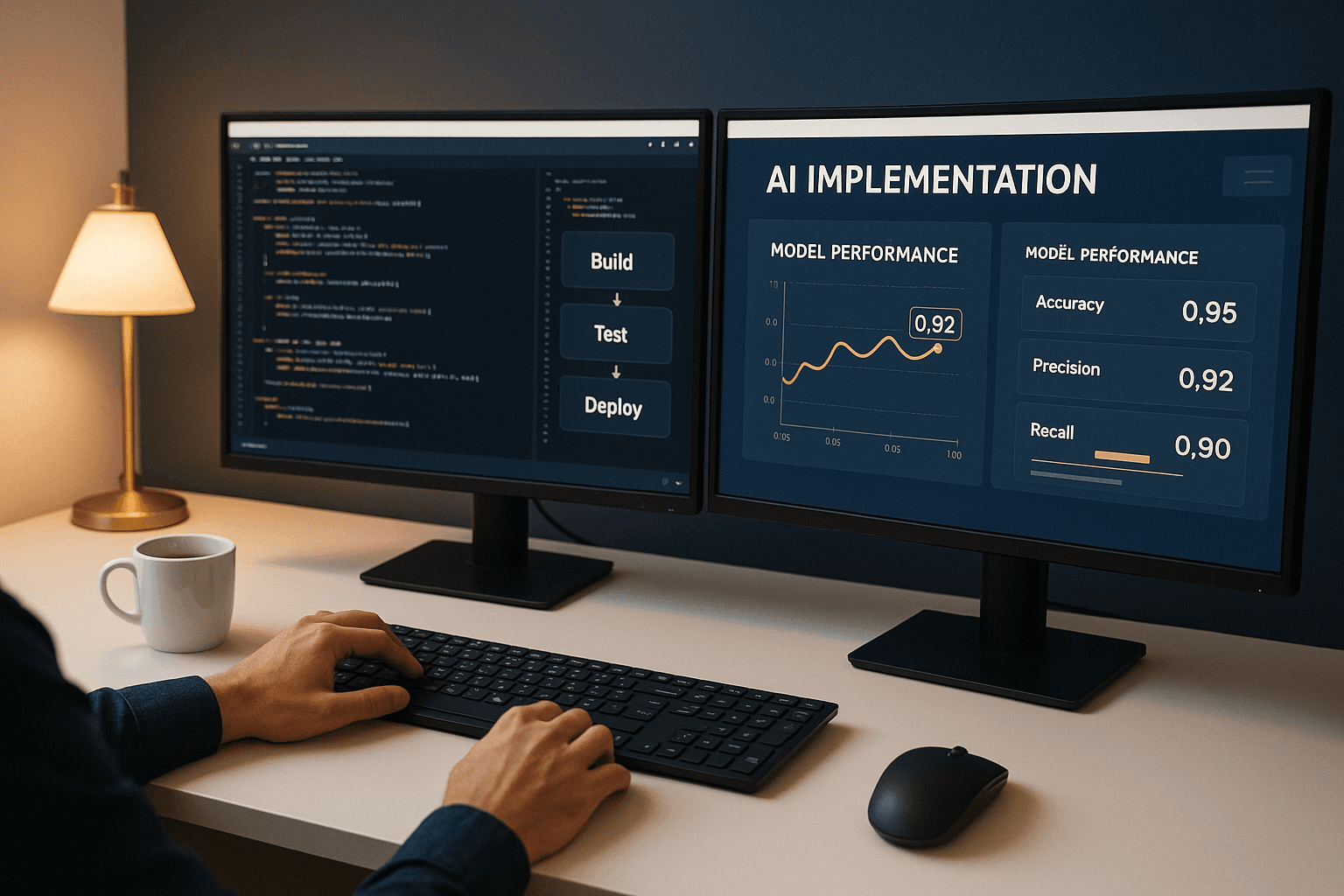
12 AI Implementation Mistakes That Kill Business Projects (And How to Avoid Them)
Most AI projects fail not because the technology doesn't work, but because of avoidable mistakes in planning, execution, and expectations. Here's what to watch for.
12 AI Implementation Mistakes That Kill Business Projects (And How to Avoid Them)
Here's a stat that should make every business leader pause: up to 80% of AI projects fail to deliver their expected value. Not because AI doesn't work — it does. The technology is more capable than it's ever been. Projects fail because of how they're implemented.
After working with dozens of businesses on AI adoption, we've seen the same mistakes repeated across industries, company sizes, and project types. This is the list we wish someone had given us before our first AI project.
1. Starting with the Technology, Not the Problem
The mistake: "We need an AI strategy" leads to buying tools before understanding what problems need solving.
What happens: A business buys an expensive AI platform, spends months configuring it, and then tries to find problems for it to solve. By the time they realise it doesn't fit, they've spent the budget and the patience.
The fix: Start with pain points. Where are people spending time on repetitive work? Where are errors costing money? Where are customers frustrated? Match technology to problems, not the other way around.
The test: If you can't describe the business problem in one sentence without mentioning AI, you're starting in the wrong place.
2. Boiling the Ocean
The mistake: Trying to automate everything at once.
What happens: A 12-month "comprehensive AI transformation programme" that tries to touch every department simultaneously. Resources are spread thin, nobody gets proper training, and the project loses momentum after month three.
The fix: Pick one process. Automate it. Measure the results. Then move to the next one. Small wins build credibility and momentum. Big-bang transformations build resentment and change fatigue.
A good first project:
- Takes less than 90 days
- Affects one team or process
- Has clear, measurable outcomes
- Doesn't require massive data migration
3. Ignoring Data Quality
The mistake: Assuming your existing data is ready for AI.
What happens: You feed AI your customer database, and it produces garbage insights because half the records are duplicated, outdated, or incorrectly categorised. AI amplifies data quality — good data gets better insights, bad data gets confident-sounding wrong answers.
The fix: Audit your data before you start. Fix the obvious issues. Establish data quality standards. Budget time and money for data cleaning — it's typically 40-60% of any AI project's effort.
Quick data health check:
- What percentage of records are complete?
- When was the data last cleaned or deduplicated?
- Are there consistent formats and categories?
- Who owns data quality, and is it in their job description?
4. No Clear Success Metrics
The mistake: "We want AI to improve efficiency" without defining what that means.
What happens: Three months into the project, nobody can agree whether it's working. The finance team says it hasn't saved money. The operations team says it's faster. The CEO asks what the ROI is and nobody has an answer.
The fix: Define success before you start. Specific numbers. Measurable outcomes. Timeframes.
Bad metric: "Improve customer service" Good metric: "Reduce average first-response time from 4 hours to 30 minutes within 90 days"
Bad metric: "Save time on admin" Good metric: "Reduce invoice processing from 15 minutes to 2 minutes per invoice, saving 40 hours per month"
5. Underestimating Change Management
The mistake: Focusing on technology and forgetting about people.
What happens: You build a brilliant AI system. Nobody uses it. The team found workarounds because they weren't involved in the design, weren't trained properly, and don't trust the outputs.
The fix: Include the people who'll use the system from day one. Not just as testers — as designers. The person who does the job every day knows more about edge cases than any consultant. Their buy-in isn't optional; it's the difference between adoption and expensive shelfware.
Change management checklist:
- Affected team members involved in requirements gathering
- Regular demos and feedback loops during development
- Training programme that covers "why" not just "how"
- Champion in each team who advocates for the new system
- Fallback plan for when things go wrong (they will)
6. Treating AI as Set-and-Forget
The mistake: Implementing AI and walking away.
What happens: The system works brilliantly for three months. Then data patterns shift, new products are added, team processes change, and nobody updates the AI. Performance degrades slowly, and by the time anyone notices, trust is gone.
The fix: AI systems need ongoing maintenance. Budget for it. Assign ownership. Schedule regular reviews of performance metrics, model accuracy, and user feedback.
Maintenance rhythm:
- Weekly: Check error rates and user-reported issues
- Monthly: Review performance metrics against baselines
- Quarterly: Assess whether the use case has changed
- Annually: Evaluate whether the tool still fits or needs replacing
7. Over-Automating Customer Interactions
The mistake: Putting AI between you and your customers for everything.
What happens: Customers hit a chatbot wall. They can't reach a human. Simple queries are handled fine, but anything requiring nuance, empathy, or actual problem-solving gets stuck in a loop. Customer satisfaction tanks.
The fix: Automate the simple stuff. Route the complex stuff to humans. Make the escalation seamless. The best customer AI knows when it's out of its depth and hands off gracefully.
The golden rule: A customer should never have to say "I want to speak to a human" more than once.
8. Vendor Lock-In Without Realising It
The mistake: Building your entire AI infrastructure on one vendor's proprietary platform.
What happens: Two years later, the vendor raises prices 40%, changes their API, or gets acquired. You're stuck because migrating would mean rebuilding everything from scratch.
The fix: Favour open standards where possible. Insist on data portability. Understand the exit costs before you sign the contract. Build abstraction layers so you can swap components without rebuilding the whole system.
Questions to ask before committing:
- Can I export my data in standard formats?
- What happens to my data if I cancel?
- How much customisation is in their proprietary system vs standard code?
- What's the realistic cost and timeline to migrate away?
9. Skipping the Pilot
The mistake: Going straight from concept to full deployment.
What happens: Edge cases nobody thought of. Integration issues with existing systems. User resistance. Performance problems at scale. All discovered in production, affecting real customers and real revenue.
The fix: Every AI project needs a pilot phase. Run it with a subset of users, a subset of data, or a subset of processes. Find the problems when they're cheap to fix.
A good pilot:
- 2-4 weeks duration
- 5-10 users maximum
- Real data, limited scope
- Daily feedback collection
- Clear go/no-go criteria for full rollout
10. Expecting Perfection from Day One
The mistake: Comparing AI accuracy to an imaginary 100% standard instead of the current human baseline.
What happens: AI achieves 92% accuracy on a task that humans do at 85%. But because someone expected 99%, the project is labelled a failure. The team goes back to manual processes that are objectively worse.
The fix: Measure AI against the current reality, not perfection. Document the human baseline first. If AI beats it on day one, that's a win. Then improve iteratively.
Reframe the conversation: "Is it better than what we have now?" is the right question. "Is it perfect?" is the wrong one.
11. No Governance or Ethical Framework
The mistake: Deploying AI without thinking about bias, fairness, privacy, or accountability.
What happens: Your AI hiring tool discriminates against certain candidates. Your pricing AI charges different amounts to different demographics. Your customer service AI shares private information. Someone notices, and now you have a PR crisis and a potential legal issue.
The fix: Establish AI governance before deployment:
- Bias testing — check outputs across different groups
- Privacy compliance — GDPR, data protection, informed consent
- Accountability — who's responsible when AI makes a mistake?
- Transparency — can you explain why AI made a specific decision?
- Review cadence — how often do you audit for fairness?
This isn't bureaucracy. It's risk management.
12. Not Investing in Internal AI Literacy
The mistake: Assuming the AI vendor or your IT team will handle everything.
What happens: Business leaders can't evaluate whether AI proposals are realistic. Managers can't identify automation opportunities in their own teams. Staff fear AI because they don't understand it. The organisation becomes dependent on external consultants for every decision.
The fix: Build internal AI literacy at every level:
- Leadership: Understand capabilities, limitations, and strategic implications
- Management: Identify automation opportunities and manage AI-augmented teams
- Staff: Use AI tools confidently, understand when to trust AI and when to escalate
- IT/Technical: Evaluate tools, manage integrations, maintain systems
You don't need everyone to be an AI engineer. You need everyone to be AI-literate enough to make good decisions in their own domain.
The Common Thread
Every one of these mistakes comes from the same root cause: treating AI as a technology project instead of a business change project. The technology is the easy part. The hard part is aligning it with real problems, real people, and real processes.
The businesses that get AI right don't have bigger budgets or better technology. They have better discipline: clear problems, measured progress, empowered people, and the patience to get it right incrementally.
Your AI Implementation Checklist
Before your next AI project, run through this:
- ✅ Can you describe the problem in one sentence without mentioning AI?
- ✅ Do you have a measurable success metric with a timeframe?
- ✅ Is the affected team involved in design and testing?
- ✅ Have you audited the data quality?
- ✅ Is there a pilot plan with go/no-go criteria?
- ✅ Have you budgeted for ongoing maintenance?
- ✅ Do you have an exit strategy from your chosen vendor?
- ✅ Is there a governance framework for fairness and privacy?
- ✅ Have you measured the current human baseline?
- ✅ Is there a training plan for all user levels?
If you can't tick all ten, you're not ready to start. Fix the gaps first. It's cheaper than fixing them in production.
Caversham Digital helps businesses implement AI the right way — with clear strategy, measured outcomes, and practical execution. Talk to us before your next AI project.