Human-AI Hybrid Teams: Restructuring Your Workforce Around AI Capabilities
AI isn't replacing your team — it's reshaping it. A practical guide for UK SMEs on building hybrid human-AI teams, the centaur model, and restructuring roles for maximum output.
Human-AI Hybrid Teams: Restructuring Your Workforce Around AI Capabilities
The conversation about AI and work has been dominated by a false binary: AI replaces humans, or it doesn't. The reality is more interesting and more profitable than either extreme.
The businesses pulling ahead in 2026 aren't choosing between humans and AI. They're redesigning their teams so each amplifies the other.
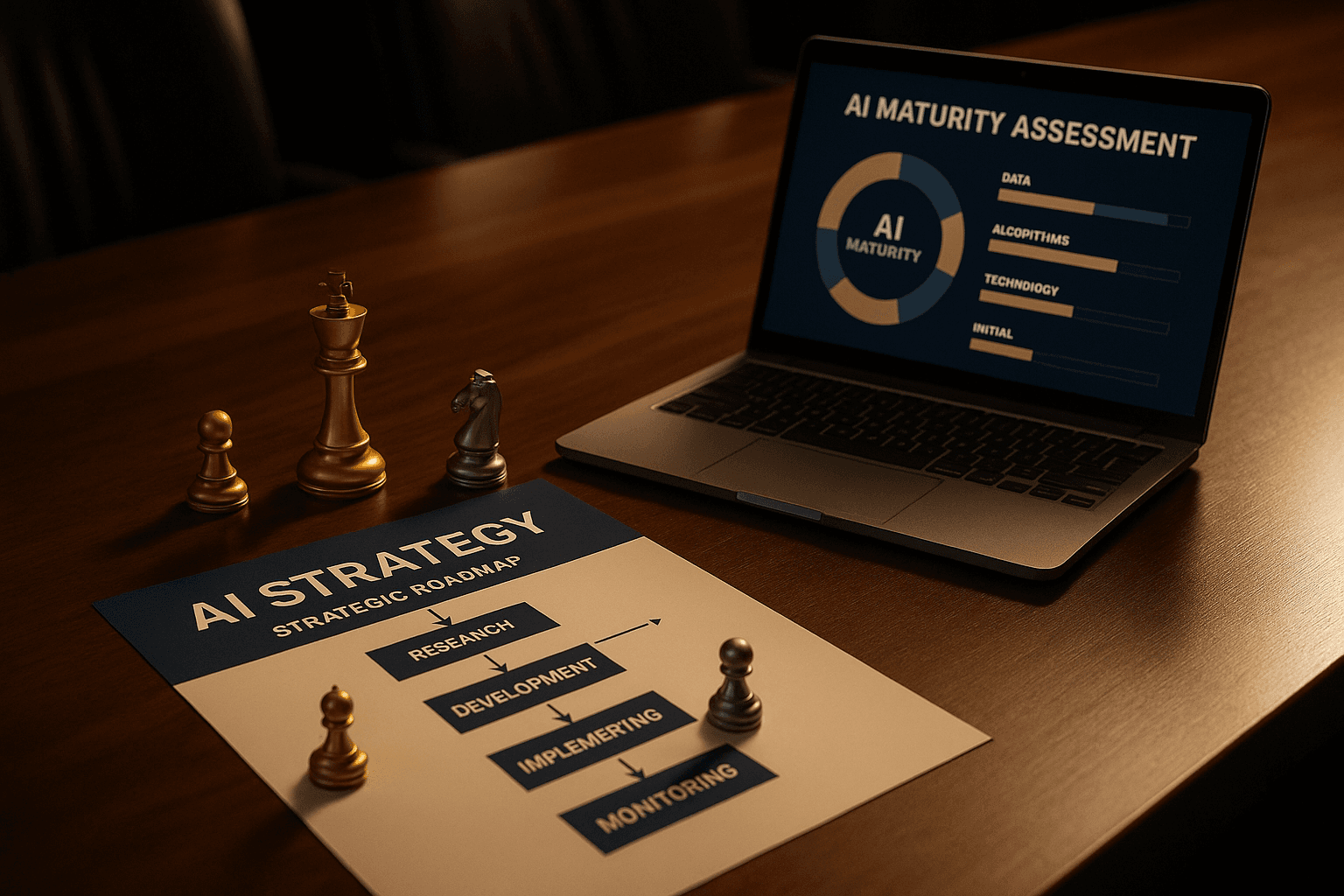
This is the centaur model — named after chess, where human-AI teams consistently beat both pure AI and pure human players. It works in business too.
Why "AI vs Humans" Is the Wrong Frame
The Replacement Fallacy
When businesses think about AI, they typically ask: "Which jobs can AI do?" This leads to either:
- Anxiety (everyone fears replacement)
- Paralysis (leadership delays adoption to avoid conflict)
- Crude automation (replacing humans with worse AI equivalents)
The Augmentation Opportunity
The better question: "What could each person achieve if they had AI handling their cognitive grunt work?"
A customer service rep who spends 60% of their time on routine queries could instead handle only complex, high-value interactions — with AI preparing context, drafting responses, and handling follow-ups. Same person, 3x the impact.
An accountant who manually processes invoices and chases payments could focus exclusively on advisory work — the high-margin, relationship-driven services that clients actually value.
The maths are compelling: A team of 5 people augmented with AI can often match the output of 15 — but with better quality, because humans focus on what humans do best.
The Centaur Team Model
How It Works
In a centaur team, every function has three layers:
Layer 1: AI-Automated Tasks that AI handles end-to-end without human involvement.
- Email sorting and prioritisation
- Data entry and validation
- Standard report generation
- Initial customer query classification
- Meeting transcription and summary
Layer 2: AI-Assisted Tasks where AI does heavy lifting but humans make decisions.
- Drafting proposals (AI drafts, human refines)
- Research and analysis (AI gathers, human interprets)
- Quality checks (AI flags anomalies, human investigates)
- Customer communications (AI suggests responses, human approves)
- Financial forecasting (AI models scenarios, human decides strategy)
Layer 3: Human-Led Tasks where humans take the lead, using AI only as a resource.
- Strategic decisions and planning
- Complex negotiations
- Creative direction and brand voice
- Relationship management
- Ethical judgement calls
- Novel problem-solving
The Magic Ratio
Most businesses find the optimal split is roughly:
- 30% fully automated by AI
- 50% AI-assisted with human oversight
- 20% human-led with AI as background resource
This means every team member spends the vast majority of their time on work that actually requires human intelligence, creativity, and judgement.
Practical Restructuring: A Step-by-Step Guide
Step 1: Audit Current Roles (Week 1)
For every role in your business, map out:
- Tasks performed (be specific — not "admin" but "updating CRM records," "formatting reports," etc.)
- Time allocation (what percentage of their week goes to each task?)
- Cognitive complexity (routine/procedural, analytical, creative, relational)
- Error sensitivity (what's the cost of getting it wrong?)
Template question for each task: "If an AI could do this 80% as well as a human, would that be good enough?"
Step 2: Identify Automation Candidates (Week 2)
Sort tasks into the three layers. Look for:
Automate completely (Layer 1):
- High-volume, low-variance tasks
- Clear right/wrong answers
- Low cost of occasional errors
- Currently taking >5 hours/week across the team
Augment with AI (Layer 2):
- Medium complexity, some judgement required
- Benefits from speed but needs human review
- High volume where draft quality would save significant time
- Currently a bottleneck in workflows
Keep human-led (Layer 3):
- High stakes, low tolerance for error
- Requires empathy, persuasion, or creativity
- Involves confidential or sensitive information
- Regulatory requirement for human decision-making
Step 3: Redesign Role Descriptions (Week 3-4)
This is where most businesses fail. They add AI tools but don't change role expectations, so people use AI to do the same job slightly faster instead of doing a fundamentally different (and more valuable) job.
Before AI — Marketing Coordinator:
- Write social media posts (40%)
- Create email campaigns (25%)
- Update website content (15%)
- Analyse campaign performance (10%)
- Strategy and planning (10%)
After AI — Marketing Strategist (same person):
- Campaign strategy and creative direction (35%)
- AI-assisted content production and review (20%)
- Community engagement and relationship building (20%)
- Performance analysis and optimisation (15%)
- Competitor and market intelligence (10%)
Same salary. Same person. Dramatically more value produced.
Step 4: Build AI Workflows (Month 2)
For each Layer 1 and Layer 2 task:
- Select appropriate AI tools (don't over-engineer — start with the simplest solution)
- Build the workflow with clear handoff points between AI and human
- Define quality thresholds — when should AI output be auto-approved vs reviewed?
- Test with a subset of work before rolling out fully
Step 5: Retrain and Support (Ongoing)
Your team needs:
- Prompt literacy — how to communicate effectively with AI tools
- Quality judgement — how to evaluate AI output (not just accept it)
- Workflow mastery — confidence with the new AI-human handoff processes
- Escalation protocols — when to override AI and when to trust it
Budget 2-4 hours per person per month for AI skills development. This isn't optional — it's the investment that makes the restructure work.
Real Examples of Hybrid Team Structures
Small Accounting Practice (8 Staff)
Before:
- 3 bookkeepers (manual data processing)
- 2 tax specialists
- 1 payroll administrator
- 1 practice manager
- 1 partner
After (same headcount, 2x capacity):
- 1 bookkeeper + AI automation (handles volume of previous 3)
- 2 tax advisors (upgraded from "specialists" to advisory roles)
- AI handles payroll processing; former admin becomes client relationship manager
- Practice manager focuses on growth strategy with AI-generated insights
- Partner spends less time on operations, more on business development
Revenue impact: Practice took on 40% more clients without hiring.
Field Service Company (15 Engineers)
Before:
- Engineers spend 30% of time on paperwork, scheduling, and admin
- Office team of 4 manages dispatch, invoicing, and customer comms
After:
- AI handles scheduling, route optimisation, and basic customer communication
- Engineers spend 90%+ of time on actual service work
- Office team reduced to 2 (others redeployed to sales and customer success)
- AI pre-diagnoses issues from customer descriptions before engineer arrives
Productivity impact: Average jobs per engineer per day went from 4 to 6.
Marketing Agency (12 People)
Before:
- 4 copywriters, 3 designers, 2 strategists, 2 account managers, 1 MD
After:
- 2 "content directors" (former copywriters who now direct AI content production + refine)
- 2 designers using AI for initial concepts and variations
- 3 strategists (added 1 — the saved capacity was reinvested in higher-value work)
- 2 account managers with AI-powered client intelligence
- 1 MD
- 2 former copywriters retrained as AI workflow specialists
Output: Agency produces 3x the content volume with better targeting. Revenue up 60%.
The Human Skills That Matter More Than Ever
As AI handles more routine cognitive work, these human capabilities become your competitive advantage:
Judgement
AI can analyse data. Humans decide what the data means in context. A model might flag that sales are down 15% — but understanding that it's because your biggest client is going through a restructure (and will bounce back) requires human judgement.
Relationships
AI can draft the perfect email. Humans build trust over time. The client who stays with you through a mistake isn't staying because of your AI — they're staying because of the person they trust.
Creativity
Real creativity — not "generate 10 variations of this headline" but "what if we approached this problem from a completely different angle?" — remains distinctly human. AI is excellent at iteration; humans are better at revolution.
Ethics
AI can flag compliance issues. Humans decide what's right when the rules are ambiguous. As AI handles more decisions, the human role in ethical oversight becomes more important, not less.
Adaptability
When everything changes — a new regulation, a market shift, a crisis — humans adapt and improvise. AI needs to be retrained. Your most valuable team members are the ones who can navigate ambiguity.
Getting Buy-In from Your Team
The biggest barrier to hybrid teams isn't technology. It's fear.
What Your Team Is Thinking
- "Am I being replaced?"
- "I don't understand this stuff."
- "This is just more work on top of my existing job."
- "What if the AI makes me look incompetent?"
How to Address It
- Be honest about the change. "We're restructuring how we work, not eliminating who works here."
- Show the upside. "You'll spend less time on the parts of your job you don't enjoy."
- Involve people in design. Let team members identify which of their tasks are candidates for AI assistance.
- Invest in training. Actions speak louder than reassurance. Budget for upskilling.
- Celebrate early wins. When someone uses AI to save 3 hours on a task, make sure the whole team hears about it.
The Conversation You Need to Have
"AI is going to change every role in this company over the next 12 months. Our choice is whether we lead that change intentionally — in a way that makes everyone's job better — or let it happen chaotically. I'd rather we do it together."
Common Pitfalls
The "Bolt-On" Mistake
Adding AI tools without changing workflows or expectations. People use ChatGPT for 10 minutes a day but their job is fundamentally the same. Minimal impact.
The Autonomy Trap
Giving AI too much autonomy too quickly. Start with AI-assisted (human reviews), then gradually move to AI-automated as confidence and quality evidence build.
Ignoring the Middle
Most attention goes to fully automated tasks (exciting!) and human-only tasks (unchanged). The real value is in Layer 2 — the AI-assisted work where quality and speed both improve.
Measuring Inputs Instead of Outputs
Don't measure "hours worked" in a hybrid team. Measure outcomes: deals closed, customers served, projects delivered, revenue generated. AI makes input-based measurement meaningless.
Getting Started This Month
- Pick one team or department as your pilot. Ideally 3-8 people.
- Run the task audit (Step 1 above). Be granular.
- Identify 3-5 tasks that could move to Layer 1 or Layer 2.
- Implement one AI workflow this month. Just one. Learn from it.
- Review after 30 days. What worked? What didn't? What surprised you?
Then expand to the next team.
The Bottom Line
The future of work isn't human or AI. It's human and AI, structured intentionally so each does what it's best at.
Companies that figure out hybrid team design will outperform competitors by wide margins — not because they have better AI, but because they have better-deployed humans.
Your team is your most expensive and most valuable asset. AI doesn't replace that investment. It multiplies the return on it.
The question isn't whether to restructure around AI. It's how fast you can do it before your competitors do.
Ready to design your hybrid team structure? Talk to us — we'll help you audit roles, identify AI opportunities, and build the workflows that multiply your team's output.