
AI Sales-to-Ops Handoffs: How South Wales SMEs Can Start Work Faster After the Quote Is Accepted in 2026
A practical guide for South Wales SMEs using AI to turn accepted quotes into clean operational handoffs, faster job starts, and less admin leakage.
AI Sales-to-Ops Handoffs: How South Wales SMEs Can Start Work Faster After the Quote Is Accepted in 2026
One of the least talked-about problems in growing SMEs is what happens right after the customer says yes.
The quote is accepted. Everybody is pleased for about five minutes. Then the job enters the fog.
Some details are in the quote document. Some are in email. Some are in somebody's notes. The delivery team gets a partial briefing. The office chases missing information. The customer assumes work is underway while the business is still trying to translate a sale into something operational.
That gap is expensive. Jobs start later than they should. Customers repeat themselves. Staff duplicate admin. Mistakes creep in because the handoff depends on memory rather than system.
For a lot of South Wales SMEs, this is one of the strongest places to use AI and workflow automation.
Not to remove human judgement. Not to auto-run projects blindly. Just to make sure an accepted quote becomes a structured, visible, actionable piece of work without three people retyping the same information.
The hidden mess after a sale
Most owners pay attention to lead generation and quoting because those stages are visible. The handoff into delivery often gets less attention because it feels internal.
That is a mistake.
The handoff from sales to operations is where a lot of businesses quietly lose margin.
It usually shows up like this:
- the customer accepts the quote but nobody creates the job until the next day or next week;
- key scope details live in attachments or message threads instead of the operational system;
- operations discovers missing information after the customer thinks the project is already moving;
- finance is unsure whether deposit, payment terms, or purchase order details are in place;
- the delivery team starts with an incomplete brief and has to ask the office, the salesperson, or the customer to fill in the gaps.
If it happens repeatedly, it becomes a structural drag on growth.
You end up with a business that can win work faster than it can operationalise it.
Why this matters more than most SMEs realise
Customers do not experience your business in departmental stages.
They do not think: "sales did a good job, operations had a separate issue."
They think: "I said yes and then everything went a bit vague."
The faster and cleaner the post-sale handoff, the more professional the business feels. That matters whether you run a trades firm, agency, consultancy, manufacturer, maintenance company, signage business, installation team, or field service operation.
It also matters internally because messy handoffs create secondary costs:
- project managers spend time reconstructing context instead of moving work forward;
- admin staff become human middleware between inboxes, spreadsheets, and delivery systems;
- leaders lose visibility because nobody can answer "where is this job up to?" without checking three places;
- new staff take longer to get up to speed because too much of the real process is tribal knowledge.
This is exactly the sort of operational problem that AI can improve when used properly.
Where AI actually helps
The useful question is not "Can AI run the project?"
The better question is: which parts of the handoff are repetitive, information-heavy, and easy to structure?
Usually, there are four.
1. Turning accepted quotes into structured job data
An accepted quote often contains everything the delivery team needs, but not in the format they need it.
AI can extract and structure:
- customer name, site address, contact details, and project location;
- products or services sold;
- exclusions, assumptions, deadlines, and dependencies;
- value, payment terms, deposit status, and quoted options;
- special notes buried in the body of an email or attached document.
Instead of someone manually copying all of that into a CRM, project board, ERP, or job sheet, AI can create a first-pass structured record for review. That alone removes a lot of delay.
2. Creating a proper internal handoff brief
When a quote is accepted, the ops team should not need to read six emails, open two PDFs, and decode what the salesperson meant by "standard install but with a tweak on the rear elevation".
AI can generate a short operational brief that says:
- what was sold;
- what needs to happen next;
- what has already been agreed with the customer;
- what is still missing;
- and what risks or ambiguities need human attention.
3. Triggering the next actions automatically
The handoff problem is not just information. It is motion.
The accepted quote should trigger the next steps automatically:
- create or update the customer record;
- open the project or job;
- assign the first internal owner;
- request missing documents or measurements if needed;
- notify finance if deposit or PO information is required;
- schedule follow-up if the job cannot start yet.
This is where automation matters as much as AI. The model helps interpret and structure the information. The workflow moves it through the business.
4. Flagging exceptions before they become delays
Not every accepted quote is clean.
Some have missing delivery dates. Some include custom terms. Some involve unclear scope, odd payment arrangements, or dependencies on site access, stock, surveys, or third-party approvals.
AI is useful here because it can spot patterns and exceptions quickly:
- missing fields;
- conflicting dates;
- non-standard payment terms;
- scope notes that do not match internal templates;
- jobs that need a human review before ops can accept them.
That is much better than discovering the problem halfway through the week when everyone assumed somebody else had checked it.
What a good handoff looks like in practice
For a South Wales SME, a sensible workflow does not need to be complicated.
A practical version looks like this:
- The customer accepts the quote by email, e-signature, payment link, or approval form.
- The system detects the acceptance and pulls together the relevant quote, thread, attachments, and customer details.
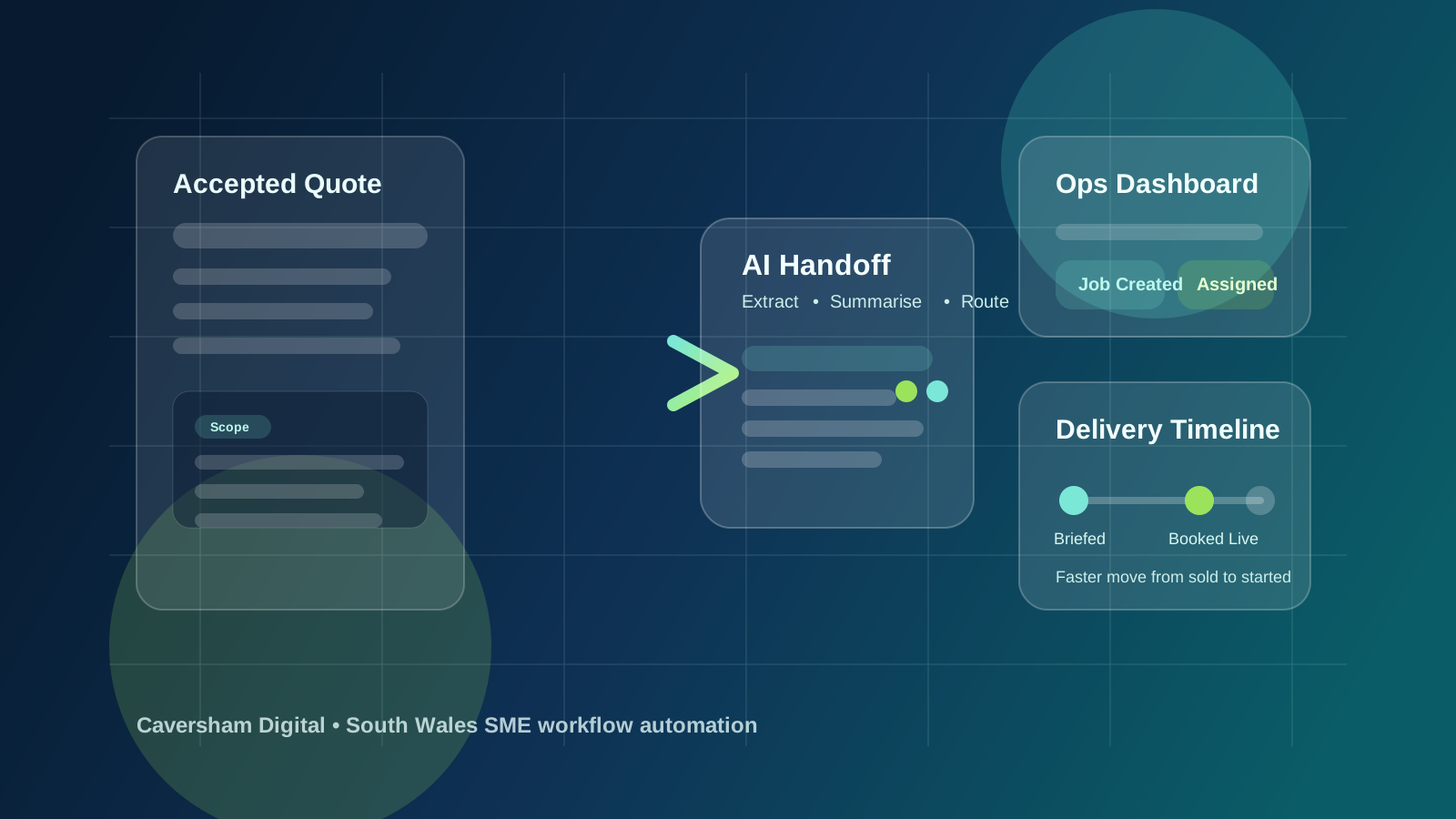
- AI extracts the key data and drafts an internal handoff summary.
- The workflow creates the job or project in the correct system.
- A human reviews any flagged issues.
- The right people are notified with a clean brief, not a pile of attachments.
- Any missing items are chased automatically.
- Management can see that the sale has moved into delivery rather than disappearing into limbo.
This is not science fiction. It is just better operational design.
The best businesses to start with
This kind of workflow is especially useful where the sale and the delivery involve different people, or where every new job generates a lot of coordination.
Common examples include:
- trades and installation businesses;
- engineering and fabrication firms;
- agencies moving from proposal to project kickoff;
- consultants onboarding new client work;
- print, signage, and production businesses;
- maintenance and service companies with scheduling and material dependencies.
In all of these businesses, the accepted quote is not the finish line. It is the starting gun.
What not to automate blindly
This part matters.
You should not let AI invent operational facts that were never agreed. You should not allow an automated workflow to create false certainty around scope, price, or delivery dates. And you should not treat every accepted quote as identical if your work includes bespoke projects or technical exceptions.
The right model is:
- automate extraction;
- automate drafting;
- automate routing;
- keep humans in charge of judgement where the cost of being wrong is meaningful.
For many SMEs, that means low-risk jobs can move quickly with light review, while larger or more unusual work gets a clear approval step before ops accepts the handoff.
That is how you get speed without sloppiness.
How to implement this without overcomplicating it
Start with one handoff. One quote type. One operational path.
For example:
- website enquiry becomes quote;
- quote becomes accepted sale;
- accepted sale becomes scheduled job.
Then answer a few basic questions:
- where does acceptance currently happen;
- what information is always needed next;
- what is usually missing;
- who owns the first delivery action;
- where does the job need to be created;
- and what gets chased manually today?
Once that is clear, you can build a workflow around the real process rather than the idealised one.
That usually means combining:
- a source of truth for quotes or deals;
- a workflow tool such as Make, n8n, or Zapier;
- AI for extraction and summarisation;
- and one destination system for operations, whether that is a CRM, project tool, ERP, or job management platform.
The point is not to add another layer of software theatre.
The point is to remove the dead time between "yes" and "work has genuinely started".
The commercial payoff
When businesses fix this handoff properly, the gains are rarely abstract.
They usually show up as:
- faster job starts;
- fewer internal clarification loops;
- less admin rekeying;
- fewer customer calls asking what happens next;
- stronger confidence from delivery teams;
- and a more professional customer experience immediately after the sale.
That translates into real value because better handoffs improve both capacity and trust.
Your team wastes less time reconstructing information. Your customers feel momentum sooner. And the business becomes more scalable because progress depends less on the memory of one salesperson, one coordinator, or one office administrator.
For South Wales SMEs, this is the sort of AI implementation I like most: practical, contained, commercially credible, and directly linked to how the business actually runs.
No hype required.
Just a cleaner move from sold to started.
If your business is good at winning work but slower than it should be at operationalising it, that is not a people problem. It is a workflow problem. And workflow problems are fixable.