AI Purchase Approvals and Supplier Chasing: How South Wales SMEs Can Remove Admin Delay Before It Becomes Operational Delay in 2026
A practical guide for South Wales SMEs using AI to tighten purchase approvals, chase suppliers more consistently, and stop internal admin from slowing delivery.
AI Purchase Approvals and Supplier Chasing: How South Wales SMEs Can Remove Admin Delay Before It Becomes Operational Delay in 2026
There is a type of delay that rarely shows up clearly on a profit and loss account, but it quietly drags on the whole business.
It happens between "we need to buy this" and "it has actually been approved, ordered and chased properly".
For a lot of SMEs, that gap is held together by email, memory, and whoever happens to be most on the ball that day. A manager needs to approve a spend. Someone needs to raise the purchase order. A supplier needs a nudge because the lead time has slipped. Another person needs to check whether the delivery date still works for the job. None of it is individually complicated. That is exactly why it gets overlooked.
But once a business gets busier, these small delays start stacking up.
Jobs start later than planned. Engineers, installers or delivery teams wait on materials. Office staff spend time asking whether something has been approved yet. Suppliers get chased late rather than early. And management only notices the problem when a customer-facing deadline is already under pressure.
This is a very good place to use AI and workflow automation.
Not to let a model buy things recklessly. Not to remove financial control. Just to make the path from request to approval to supplier follow-up more structured, more visible and far less dependent on human memory.
The real problem is not purchasing. It is operational fog.
Most owner-led businesses do not think of themselves as having a procurement process. They think they just buy what they need when they need it.
That works until spend decisions start affecting live delivery.
At that point, the issue is not whether the business can technically place an order. The issue is whether the business can do it with enough speed, consistency and visibility to avoid avoidable delays.
The warning signs are usually familiar:
- requests for materials or external services arrive by email, WhatsApp, phone call, or passing conversation;
- approval thresholds exist informally but are not enforced consistently;
- somebody in the office has to chase managers to approve spend;
- suppliers are only followed up when someone suddenly realises the job date is getting close;
- nobody can answer "has this been approved and ordered yet?" without checking several places;
- the same team ends up re-keying supplier, cost or delivery details into multiple systems.
This is not a dramatic failure. It is the slower kind. The sort that drains margin through friction.
Why it matters more for South Wales SMEs than people think
Many SMEs in South Wales run lean. That is often a strength. Teams know the work, move quickly and do not hide behind unnecessary layers.
The downside is that admin control points can become overly person-dependent.
If approvals sit with one director, one ops manager, or one senior administrator, every interruption ripples outward. If supplier follow-up depends on one person remembering who promised what, delivery dates become shakier than they need to be. If purchase requests are scattered across inboxes and message threads, the business starts operating with poor visibility over its own commitments.
That affects more than the buying function.
It affects planning, scheduling, cash flow, customer communication and team confidence. When people do not trust that materials, subcontractors, or outside services will land when expected, they build contingency into everything. That means slower starts, more checking, more interruptions, and less capacity overall.
This is why a better approval and chasing workflow can create disproportionate value. It removes drag in the middle of the machine.
Where AI is actually useful
The strongest AI use cases are usually the unglamorous ones.
In this case, that means using AI to interpret requests, structure information, summarise status, and trigger the next sensible step.
For example, AI can help with four things.
1. Turning loose requests into structured purchase actions
Most purchase requests do not arrive in a clean format.
They arrive as:
- "Can we get this ordered today?"
- a forwarded supplier quote;
- a screenshot from site;
- a message saying stock is running low;
- a note in an email thread about a subcontractor slot that needs confirming.
AI can extract the practical details from that mess:
- what is being requested;
- who asked for it;
- supplier name and quoted value;
- required-by date;
- related customer job or project;
- whether the request fits a known category or needs review.
That means the business does not need somebody manually translating every scrappy message into a usable internal record.
2. Routing approvals properly
Approval is where small delays become compound delays.
If there is no clear route, requests sit in limbo. If everyone can approve, nobody owns it properly. If only one person can approve, everything queues behind them.
AI does not solve that by itself, but it does help enforce the logic once you define it.
For example:
- low-value routine spend can go to a team lead;
- project-specific spend can route to the project owner;
- unusual or margin-sensitive requests can escalate to a director;
- incomplete requests can bounce back automatically for missing information.
That is useful because it turns "can someone look at this?" into a defined operational path.
3. Generating clean supplier follow-up
Supplier chasing sounds basic until you measure how inconsistently most businesses do it.
The supplier was meant to confirm lead time on Tuesday. Nobody followed up. The revised date was buried in an email reply. The project team assumed materials were on track. By the time the issue becomes visible, there is very little room left to solve it.
AI can help by drafting and scheduling the boring but necessary follow-up:
- confirm order receipt;
- request delivery date confirmation;
- flag late acknowledgements;
- summarise supplier responses into the job record;
- escalate if promised dates slip or become vague.
The point is not that AI writes especially clever emails. The point is that the chase happens on time and the answer becomes visible to the rest of the business.
4. Surfacing risk before it hits delivery
This is where the real value sits.
If the system knows a purchase relates to a live job, a required date, and a supplier commitment, it can flag problems early:
- approval still pending too close to required date;
- supplier has not acknowledged the order;
- lead time longer than expected;
- quoted amount does not match budget or job assumptions;
- partial delivery risk with no contingency noted.
That is better than finding out on the morning somebody was supposed to be on site.
What a good workflow looks like
For most SMEs, the right design is not over-engineered.
It looks more like this:
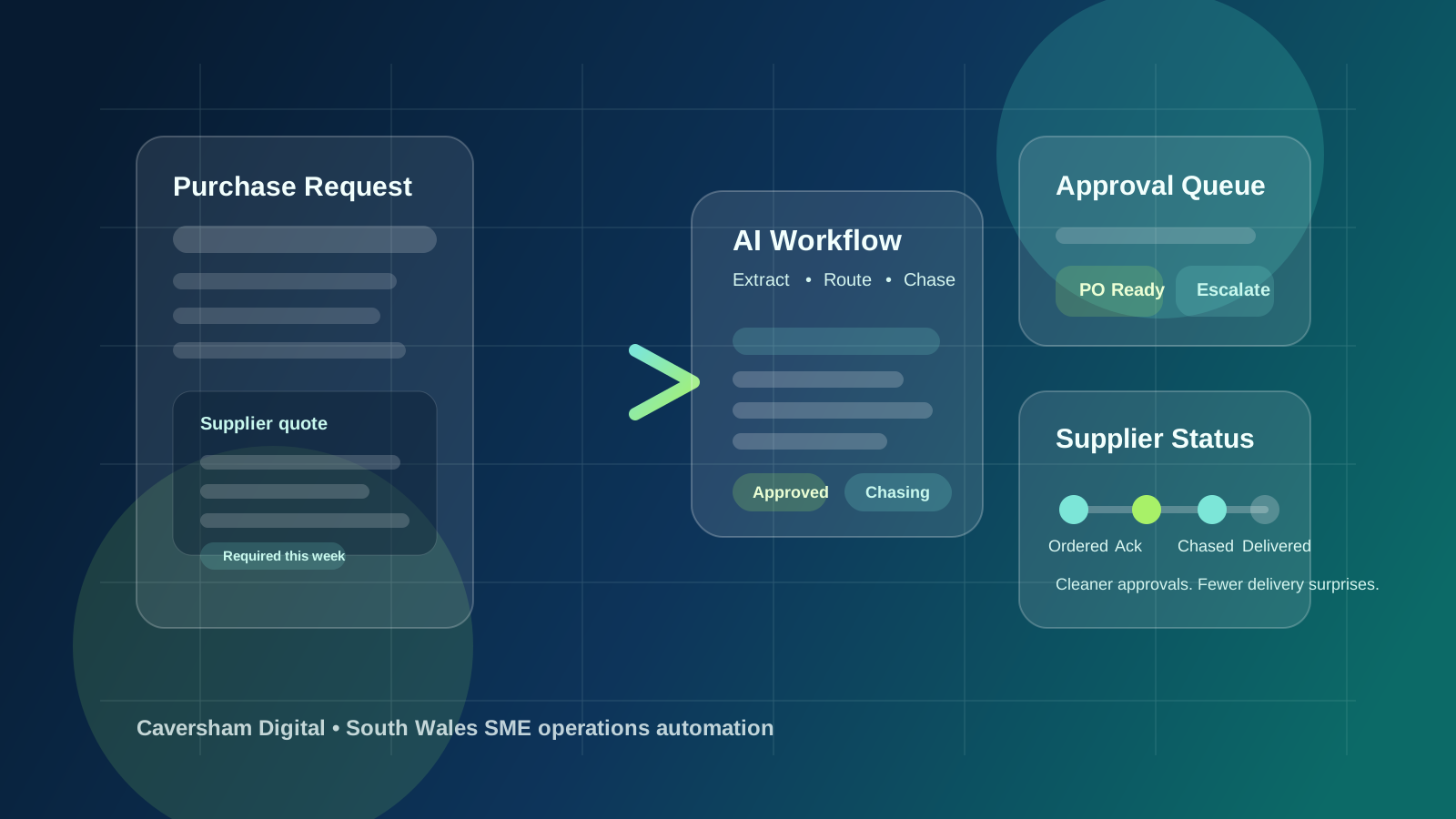
- A purchase need is raised from email, a form, a CRM record, a project board, or a site message.
- AI extracts the relevant details and creates a structured request.
- The workflow checks category, value, urgency and linked job.
- The request routes to the correct approver with a short summary, not a messy thread.
- Once approved, the PO or order step is triggered in the right system.
- Supplier acknowledgement is monitored automatically.
- Follow-up prompts or drafted chasers appear when confirmation is late or dates move.
- The delivery or project team can see status without asking around.
That is a better operating system for the same underlying work.
What not to automate blindly
This matters as much as the opportunity.
You should not let AI commit spend with no controls. You should not let it approve exceptions it does not understand. And you should not treat supplier communication as harmless if it affects contractual delivery dates, margin, or customer commitments.
The sensible model is:
- automate extraction;
- automate routing;
- automate reminders and first-draft follow-up;
- keep human approval on meaningful spend, unusual requests, or any commitment with downstream risk.
That gives you speed without surrendering judgement.
For a lot of SMEs, this is the sweet spot. Routine, repeatable requests move faster. Higher-risk cases get better visibility and cleaner escalation.
Where to start if your process is still mostly manual
Do not start by trying to redesign all purchasing in one go.
Start with one lane where delays cause real operational pain.
Usually that means one of these:
- materials for scheduled jobs;
- subcontractor bookings tied to delivery dates;
- regular supplier orders with inconsistent acknowledgement;
- ad hoc spend requests that currently bounce around management inboxes.
Then answer a few plain questions:
- Where do requests currently originate?
- What information is always needed?
- Who genuinely needs to approve what?
- Which suppliers need active chasing rather than passive waiting?
- Where should status live so the team can trust it?
- What counts as an exception?
Once that is clear, the tooling becomes much easier to choose.
In practice, the stack might include:
- a form, inbox, or project system as the request source;
- a workflow layer such as n8n, Make, or Zapier;
- AI for extraction, summarisation and exception flagging;
- and a destination system such as your CRM, ERP, finance platform, purchasing log, or internal dashboard.
The goal is not to build a procurement empire.
It is to stop ordinary spend approval and supplier follow-up from quietly disrupting delivery.
The commercial payoff
When this works properly, the gains are not theoretical.
They show up as:
- fewer late orders;
- faster approvals on routine spend;
- better visibility over what is waiting and why;
- less manual chasing by office staff;
- fewer delivery surprises caused by missing materials or weak supplier follow-up;
- stronger internal confidence in scheduling and customer commitments.
It also improves management quality.
Leaders stop spending time acting as a human notification layer. Teams stop interrupting each other just to find out whether something has moved. And the business becomes easier to scale because progress is less dependent on one reliable person carrying the whole process in their head.
For South Wales SMEs, this is the kind of AI implementation that makes immediate operational sense. It is practical. It is commercially grounded. And it improves a part of the business that often causes more friction than owners realise.
If approvals are slow, supplier follow-up is inconsistent, or jobs keep getting squeezed by internal lag, that is not just a purchasing nuisance.
It is a workflow design issue.
And workflow design issues are fixable.